
AI-Powered Enterprise Search
Intent-driven, conversational discovery across Cisco CX and PX Cloud
Search….
Overview
Role
Lead UX Design
Senior Product Designer
Initiated an AI-powered search experience across Cisco CX and PX Cloud, transforming a keyword-based system into an intelligent discovery platform.Introduced intent-driven search, predictive suggestions, and improved relevance to enable faster, more accurate access to content.
Collaboration
Product Manager, Developers, Researcher, PX Design Team
Platform
Cisco CX | PX Cloud
Problems & Opportunities
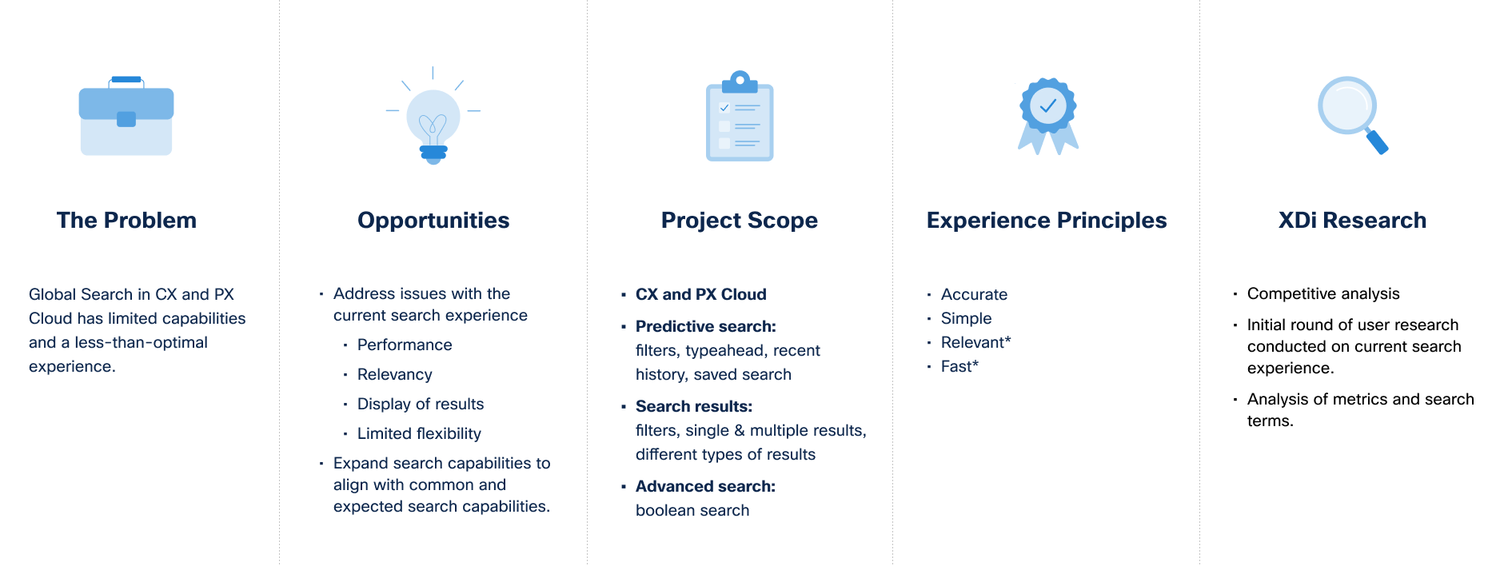
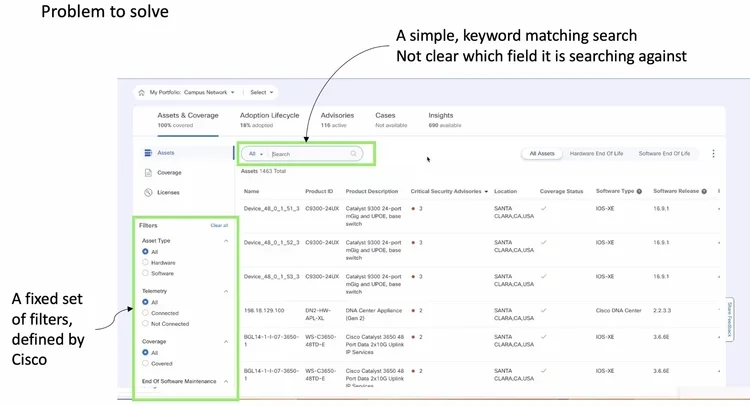
Inefficient, Keyword-Based Search
Slow, inaccurate results driven by keyword matching, limiting relevance and discoverability.
Fragmented Navigation
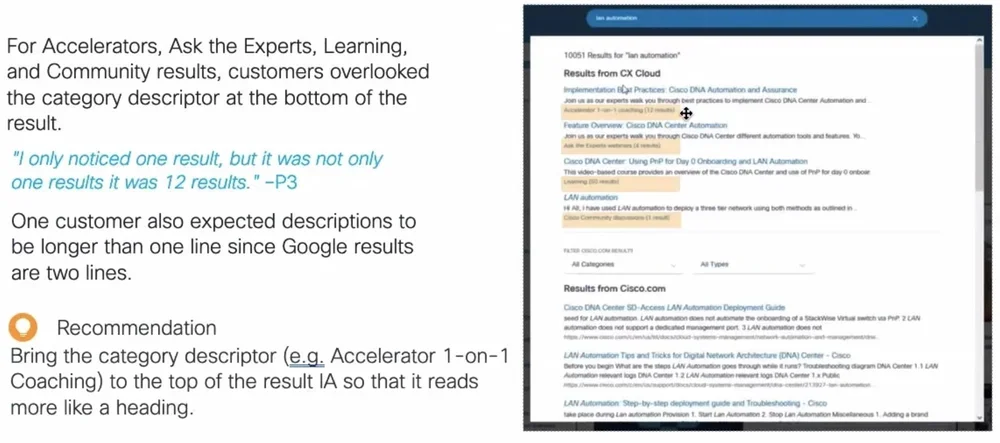
Endless, unstructured results make it difficult to scan, compare, and find meaningful insights.
Lack of Intelligence & Control
Limited filtering, personalization, and guidance reduce efficiency and prevent users from refining search effectively.
User Insights

Customer
Quickly find relevant products, services, and support resources to manage and optimize their Cisco environment.

Partner
Efficiently discover programs, tools, and sales resources needed to support customers and grow their business.

Internal User
Access customer insights, cases, and operational resources rapidly to resolve issues and deliver better support.
Users exhibited two distinct search intents within CX/PX Cloud:
Inventory Search — locating specific assets
Information Search — exploring broader knowledge across the ecosystem
A single, undifferentiated results list failed to support these intents, often returning irrelevant results and slowing users down.
This insight led to designing an intent-aware search system that distinguishes user goals and organizes results accordingly—enabling faster, more relevant discovery.
Research & Studies
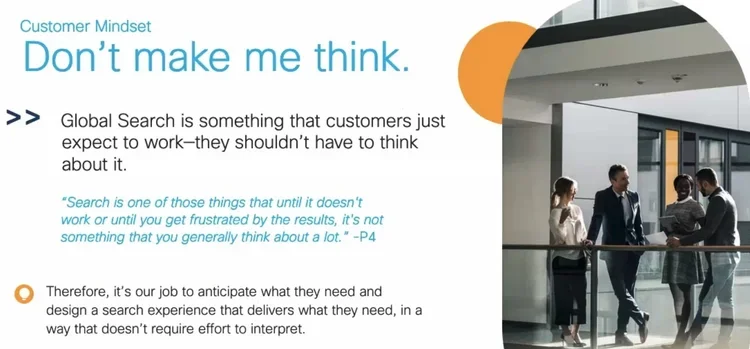
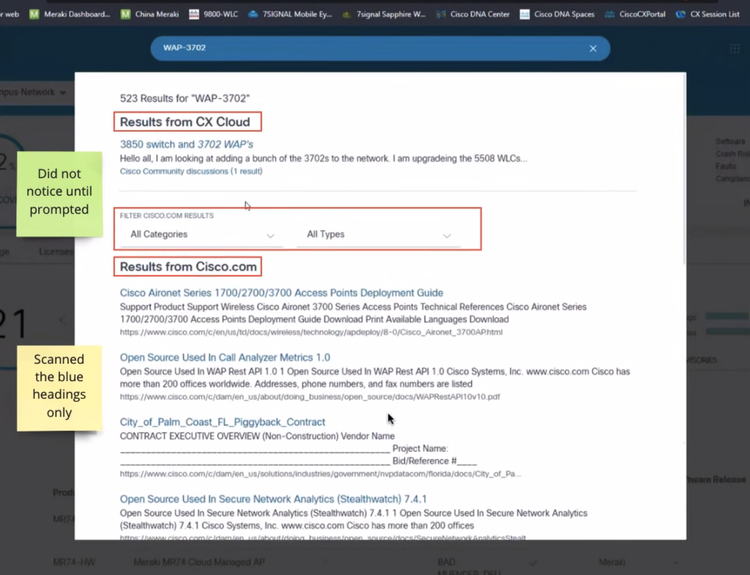
Conducted early research and discovery to understand user needs, workflows, and common search behaviors.
The screenshots below highlight key insights that validated critical tasks and informed design decisions before moving into solution design.
The Behavioral
Search Model
I mapped the end-to-end search experience to bridge the gap between user intent and functional requirements. By aligning Jobs-to-be-Done with emotional criteria and technical touch points, I established a framework that ensures every interaction from initial awareness to final action is both intuitive and contextually relevant.
Search Journey
Mapped the search journey from initial query to action, revealing how users progressively refine intent.
Each stage informed the design of guided refinement, adaptive filtering, and AI-assisted suggestions, helping users quickly surface the most relevant results.
Discover → Narrow → Explore → Refine → Evaluate → Act
Design Execution
High-fidelity mockups were created directly in Figma to accelerate design exploration and iteration.
This approach enabled rapid prototyping, usability testing, and UI validation without a separate wire-framing phase.
Predictive Search
Surfaces query suggestions based on previous search patterns to help users start searches faster.
Knowledge Module
Dedicated knowledge panels highlight relevant insights, answers, and guidance directly within search results.
Typeahead
Displays real-time suggestions as users type, helping them refine queries and reach relevant results quickly.
Card-based Design
Modular card layouts surface key content and metadata, making results easy to scan and compare.
Advanced Search
Supports Boolean operators to combine keywords and refine queries for more precise search results.
Search Result List View with Filters
Structured results and dynamic filters help users quickly scan, refine, and find relevant content.
Iteration
I improved search relevance, efficiency, and usability through continuous testing and iterative refinements, . The solution scaled across both CX and PX portals, creating a unified discovery experience for Cisco customers and partners.
→ High-fidelity mockups were created in Figma to visualize the designs and interaction flows.
User Feedback Design
I introduced a post-launch feedback survey to evaluate the effectiveness of Global Search two months after implementation.
This structured feedback helps the team measure user satisfaction, identify usability gaps, and guide future improvements.
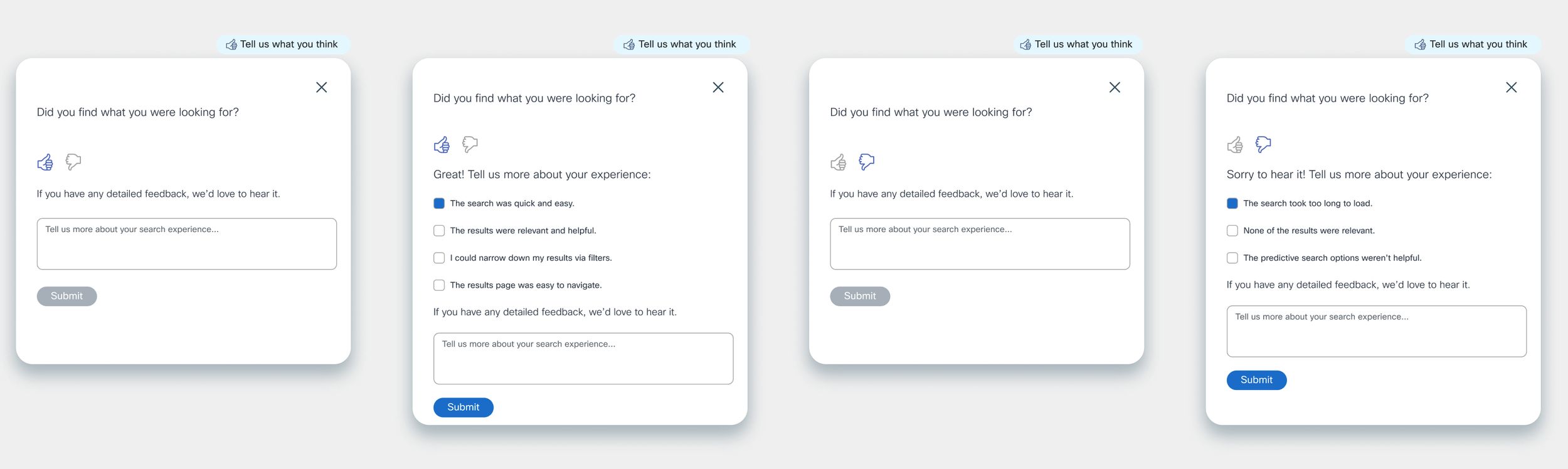
→ An always-available feedback channel allows users to quickly share their experience at any point in their journey.
Continuous user insights help the team identify pain points early and drive ongoing improvements to the search experience.
First-Time User Experience (FTUE)
I led the design and implementation of a user-centered onboarding flow to improve the Global Search first-time user experience. By grounding decisions in user expectations and journey mapping, and surfacing less discoverable features, I introduced contextual coach marks to reduce friction and support feature adoption, ensuring users feel guided and confident from the start.
→ For minor releases, the experience begins directly with the first WalkMe coach mark, avoiding a modal interruption.
→ For major releases or new products, a launch modal introduces key updates with clear, concise information. Prominent “Skip” and “Close (X)” options allow users to exit the tour at any time.
User onboarding extends beyond the initial interaction. During the first moments of product use, users form critical perceptions and expectations. A well-designed FTUE provides clear guidance and context, building confidence and setting the foundation for long-term engagement.
→ Quick guidance to help users learn and use search features efficiently.
How I Designed the
AI Experience
AI Design Framework
Designed AI as a system, not a feature, focusing on how intelligence appears in the experience to feel useful, trustworthy, and actionable.
• Reduced cognitive load through intent-driven interactions
• Provided explanations where users needed clarity, not just signals
• Connected recommendations directly to decisions and outcomes
AI Capabilities
• Intent-based semantic search (beyond keywords)
• Conversational query refinement
• AI-generated summaries and insights
• Explainable results with feedback loops
• Cross-platform knowledge discovery
AI-Powered
Interaction Flow
Designed AI to guide users from query to action, adapting to intent, refining results, and enabling faster decision-making.
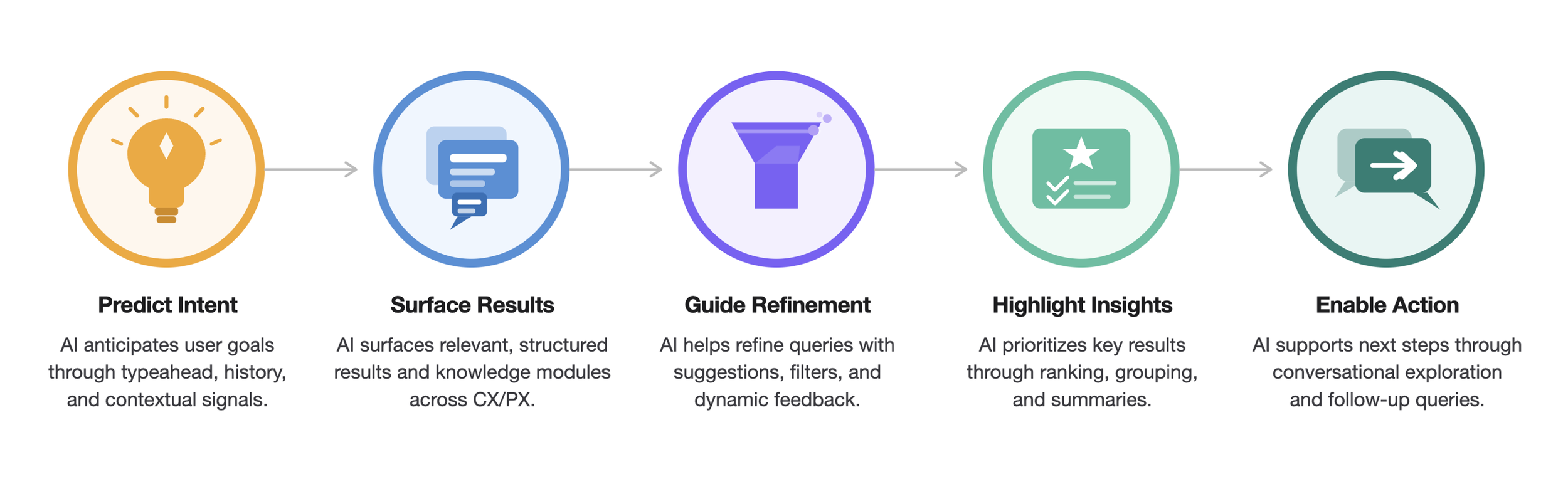
AI-Enabled Search
Explored AI-enabled search approaches to improve discovery and reduce friction in the CX/PX Cloud experience.
Concepts included AI Chatbot assistance, Predictive Search based on user history, and a AI-Generated Follow-up (ChatGPT-like) Prompt to refine queries and surface more relevant results.
II. AI Chatbot
I. Predictive Search based on user search history
III. AI-Generated Follow-up (ChatGPT-like) Prompt
1.) AI-Generated Follow-up Prompt (Ask Again)
2.) User-Guided Query Refinement Options
3.) Feedback Loop Processing
4.) Refined & Improved Results
Explainable AI Search with Feedback Loop
I introduced an explainable AI search experience with a continuous feedback loop, enabling users to understand not just what results are returned, but why. By surfacing reasoning such as usage patterns and peer benchmarks and providing guided refinement, the system supports iterative query improvement. This approach builds trust, improves result relevance, and evolves into a learning system that adapts to user behavior.
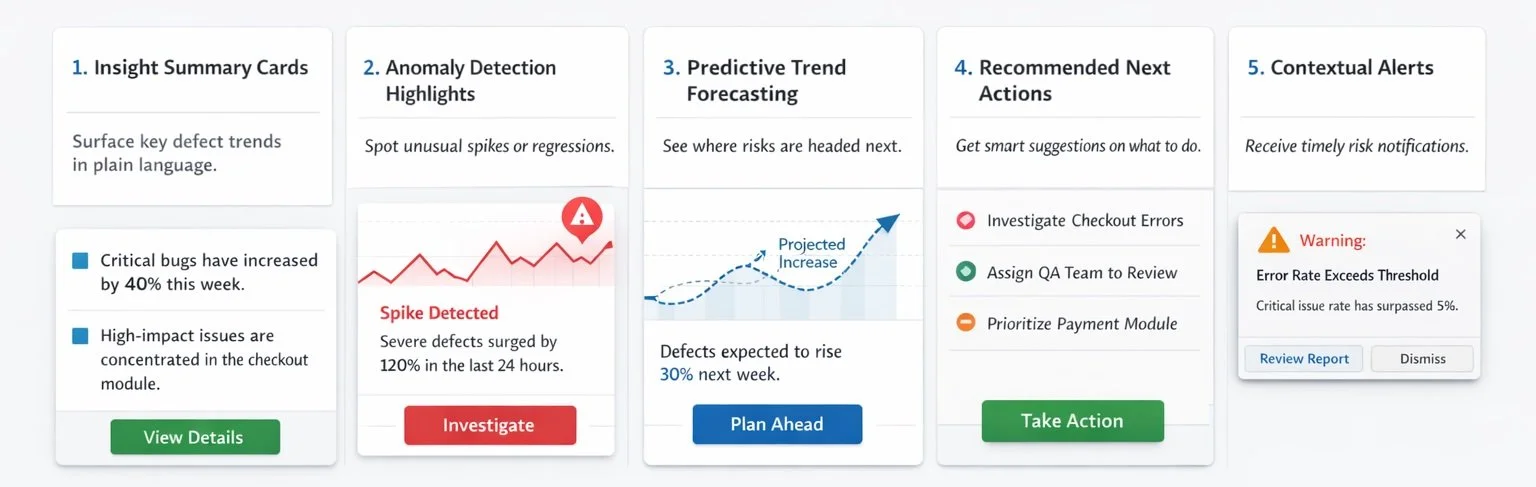
AI Design Patterns
To make defect reporting more proactive and actionable, I introduced AI UX patterns that help users move from passive monitoring to faster understanding, prioritization, and decision-making.
Prototype & Usability Testing
Created interactive prototypes to visualize the search journey and validate the design.
Usability testing helped confirm the effectiveness of navigation, result presentation, and refinement mechanisms.
→ Predictive Search
Impact
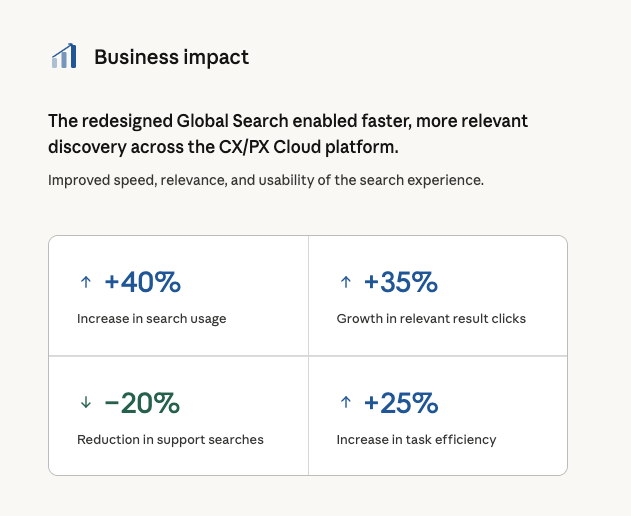
The redesigned Global Search significantly improved content discoverability across the CX/PX Cloud platform.
By enabling faster access to relevant information, the experience helps reduce user friction and supports more efficient task completion.
Final Cross-Device Experience
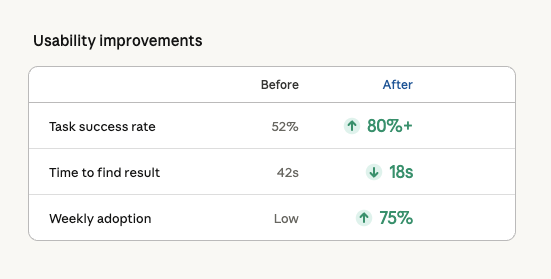
The redesigned Global Search transformed discovery across CX and PX, making it faster and easier for users to find relevant information. The experience achieved 80%+ efficiency and 75% weekly adoption, demonstrating strong adoption and measurable improvements in usability and search effectiveness.
SUCCESSFULLY
LAUNCHED!